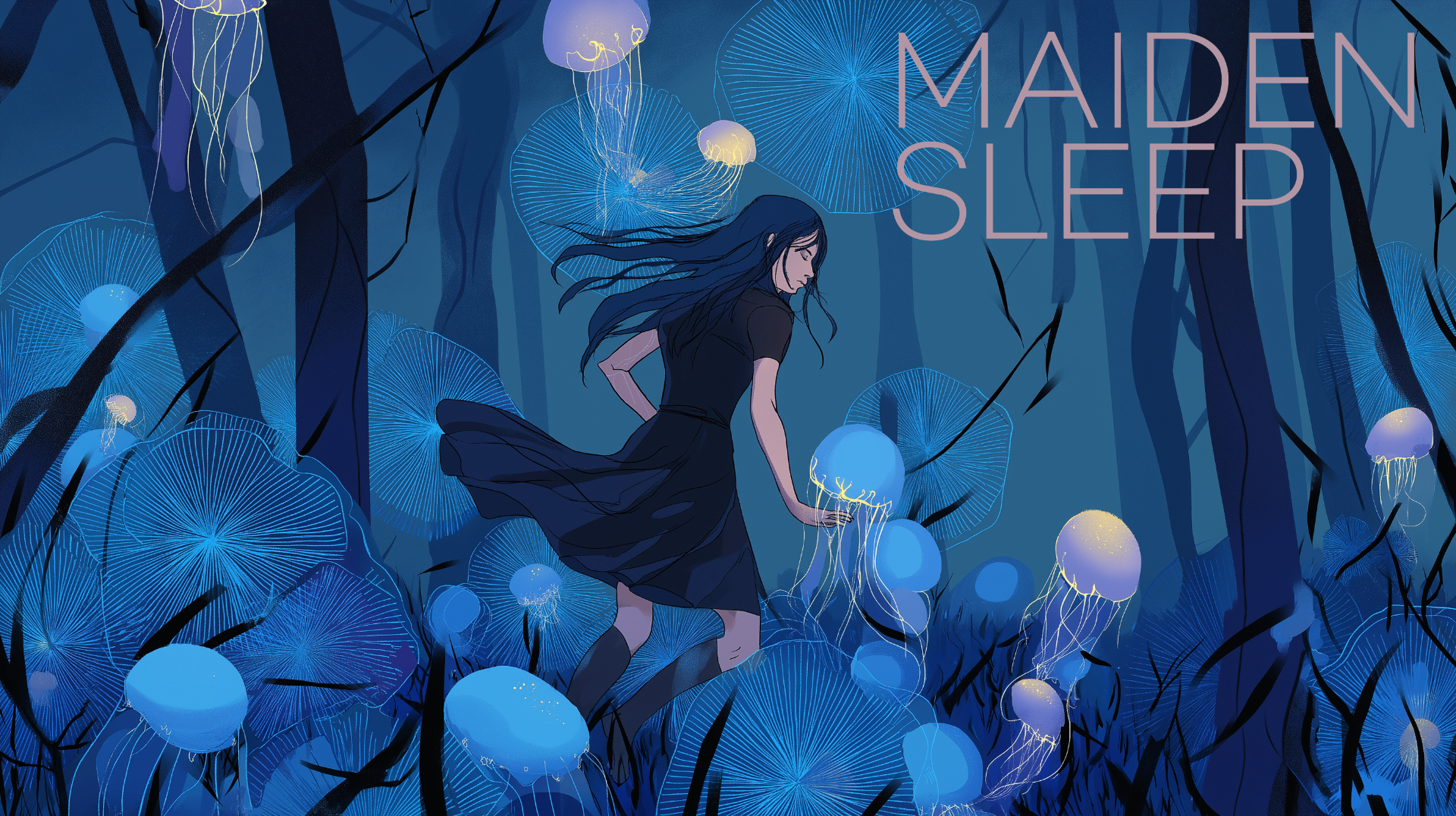
Maiden Sleep — narrative project by Adam Evans, 2024 Draft

    narrative · 2024 DraftUnproduced

    Maiden Sleep

    A mother sleepwalks toward a forest that wants her.

    Role

    Writer

    Genre

    Surreal Dreamlike Drama

    Status

    Feature Screenplay / Feature Screenplay / Draft 2 / 85 Pages

    About the Project

    A mother whose rare sleep disorder makes her create art while unconscious checks into an elite treatment institute after a near-fatal episode, only to uncover a forest commune that reveres her condition as a gift, forcing her to choose between being "cured" for her family and reclaiming the buried part of herself that refuses to stay asleep.

    Plot Summary

    Claire is a mother living in quiet suburban routine when a terrifying sleepwalking episode reveals a rare condition known as Artistic Somnambulism. While asleep, she creates intricate performances and works of art without any conscious memory. After nearly falling from the roof of her home during one of these episodes, Claire is admitted to Calmwood, an elite sleep treatment institute that promises to cure the disorder. Inside the facility, Claire enters a controlled world where creativity is treated as a symptom to be suppressed through experimental mushroom-based treatments and strict monitoring. While trying to regain control of her life for the sake of her husband Pete and their young daughter Florence, Claire begins to question whether the part of herself Calmwood wants to erase might be the most honest expression of who she truly is. At Calmwood, Claire befriends Gabrielle, a nurse who was once a patient herself, and learns that some people believe Artistic Somnambulism is not an illness but a form of unconscious creative awakening. Gabrielle secretly leads Claire out of the institution and into a hidden forest commune where former patients live without medication, embracing their nighttime performances as sacred expression. In the woods, Claire experiences a profound creative liberation as her sleep-dancing intensifies and her art becomes communal ritual. But the freedom comes with its own dangers. Romanticizing creativity can be as controlling as suppressing it. As Claire's estranged mother Anna's health declines and Florence continues to struggle with sleep of her own, Claire realizes the life she wants cannot exist entirely in either world. Claire returns to Calmwood and helps dismantle the system that commodifies the condition, but ultimately chooses to undergo the final treatment that suppresses her unconscious artistry so she can return home to her family. Back in her ordinary life, however, the absence of that creative impulse leaves her feeling hollow. One night, she secretly takes the remaining dose meant to erase the condition entirely, allowing the gift to resurface. The film ends with Claire dancing in her daughter's room while Florence watches, suggesting that creativity, like dreaming, can be delayed but never fully erased.

    Why This Exists

    Maiden Sleep comes from a question that sits at the center of my work: what parts of ourselves quietly disappear when we step into the roles life asks us to play? The film follows Claire, a mother whose body creates art while she sleeps, as if her unconscious is refusing the silence her waking life demands. That premise emerged from thinking about how creativity often survives in hidden spaces, late at night, in private rituals, in the corners of our minds where responsibility and expectation can't fully reach. I'm drawn to stories where expression isn't just a choice but a compulsion, something the body insists on even when the world asks you to suppress it. In Maiden Sleep, creativity becomes both a gift and a disturbance, an instinct that refuses to stay buried.

    At its heart, the film explores the tension between identity and obligation: motherhood and individuality, care and selfhood, stability and the quiet pull of a more authentic life. The story moves between institutions that try to control creativity and spaces that romanticize it, asking whether either world truly allows someone to live freely. Through Claire, her restless daughter Florence, and the fading memories of her own mother, the film looks at how identity moves across generations, how dreams are inherited, forgotten, and sometimes rediscovered in unexpected ways. Like much of my work, Maiden Sleep lives in contradiction: it's about the cost of suppressing who you are, but also the cost of reclaiming it.

    Comparable Titles & Inspiration Points

    • Suspiria (Luca Guadagnino)
    • The Red Shoes (Michael Powell & Emeric Pressburger)
    • Saint Maud (Rose Glass)